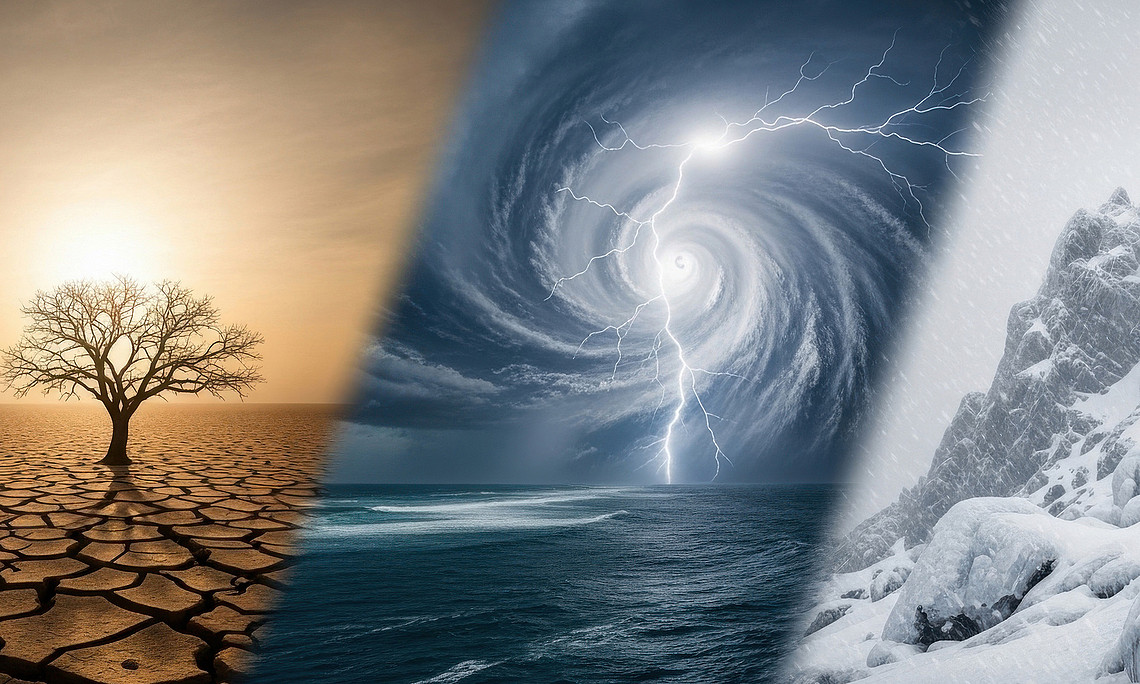



Whilst policymakers gather next Monday in Antalya, Türkiye, for the UN Climate Conference (COP), the El Niño phenomenon is causing water temperatures in the tropical Pacific to exceed 30 degrees Celsius. It will reach its peak near the turn of the year and will surpass all previous events in terms of severity. The impacts are already being felt at the American west coast: heavy rainfall has led to flooding and landslides in Peru, for example, whilst California has declared a state of emergency in anticipation of violent thunderstorms. In Central Europe, impacts will be felt until the autumn of 2027. “Due to the warming effects caused by El Niño, another summer of above-average heat and drought is likely,” explains Gottfried Kirchengast from the Wegener Center and Department of Physics of the University of Graz. This is unusual, as an extreme situation such as that of 2026 is normally followed by a more relaxed period. This time, however, El Niño – exacerbated by climate change – could prevent such a pause.
The climate phenomenon will also have a massive impact on Africa: “Various regions expect crop failures of over 50 to 70 percent, which is a tragedy for the local people and, due to global economic interdependencies, will also affect us in Europe,” adds Kirchengast.
Skillful forecast based on the latest data
Together with his PhD student Moritz Pichler, the climate researcher has recalculated the expected global warming for this year and 2027. To do so, the pair drew on temperature data up to September 2026, seasonal forecasts up to December 2026, annual temperature cycles from strong El Niño years since 1980, and El Niño forecasts up to July 2027. The results are freely available as part of the ClimTrace3.0 dataset (see Reference Dataset). For comparison, the researchers have also determined and provided expected results related to the somewhat different calculation approaches used by the European Copernicus Climate Change Service and the World Meteorological Organization reporting (see graphics below).
The warming turns out to be even more pronounced than first predicted back in June during the early El Niño phase, with a rise in global surface air temperature of 1.65 °C this year and as much as around 1.8 °C by 2027 relative to pre-industrial levels. “Up to near 0.25 degrees of this increase next year is attributable to El Niño. At the same time, the long-term forcing due to human-made emissions will contribute more than 1.5 degrees for the first time,” explains Kirchengast. “From a science perspective, it is impressive to know all this a year in advance. However, it is very sad to also see all the coming losses and damages that could have been avoided. The urgency for climate action could not be made any clearer.”
Reference Dataset:
The new reference dataset (ClimTrace3.0) including the forecast results is available via the Graz Climate Change Indicators – ClimateTracer web portal: https://climatetracer.earth (data section “Warming – Global surface temperature change”; direct download of the dataset in xlsx format)
The “Graz Climate Change Indicators” project is part of the Field of Excellence “Climate Change Graz” at the University of Graz.