Arts & Climate Change
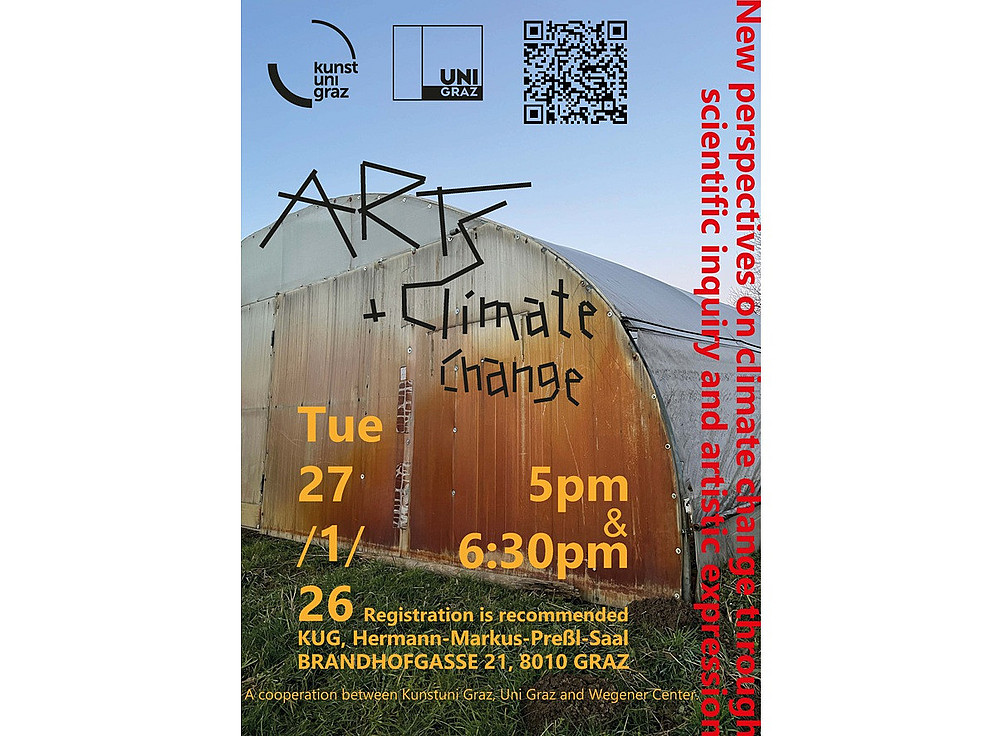
Einladung zu den Abschlusspräsentationen des interdisziplinären Kurses „Arts and Climate Change“, in dem Studierende der Universität Graz und Studierende der Kunstuniversität Graz gemeinsam Themen des Klimawandels aus sozial- und naturwissenschaftlicher sowie künstlerischer Sicht untersucht haben.
>> Alle Infos
Bitte um Anmeldung per Mail: lissa.gartler(at)kug.ac.at
- Dear Future Me
Climate Change, caused by man-made emissions, can only be effectively countered if we reach a state of net-zero emissions. But what does such a net-zero society look like? How can we reach it? What would our life look like then compared to now? Right now, net-zero might still feel abstract and hard to imagine. Dear Future Me tries to bridge this gap between the present and the future, following the thoughts of a young protagonist.
- How does it make you feel? – Voices of climate change
Numbers, statistics, facts. We are flooded with information about climate change and are aware of its consequences. But how do you actually feel about it? Are you given a voice to express your thoughts and feelings? That is precisely what we wanted to achieve with our sound installation. To give young adults around the world the opportunity to tell us how they feel and give us an insight into their everyday lives.
- Echoes of a warming world
This art project shows how local events can have global repercussions. An interactive installation featuring a globe uses light and sound to bring these connections to life. Each interaction generates a unique, approximately 30-second piece of music and visual signals that illustrate which regions of the world are affected. The sounds are generated from environmental and social data as well as global catastrophic events, which are processed using stochastic models (Markov chains). Instead of long texts or numbers, the installation uses light, sound and interaction. Visitors can trigger something themselves and experience how actions have different consequences depending on the location.
At the centre is a globe that responds to button presses. These inputs are processed by a Raspberry Pi, which forms the technical heart of the installation. It controls the LEDs in the globe, plays sounds and provides appropriate visual and acoustic responses. The technology remains in the background and serves as a creative tool to make global connections visible and audible. The installation invites visitors to try it out.
- Tipping away…
Scientific facts are crystal clear in their warning: the Earth system - the very foundation of our social life - is on the brink of tipping. And yet they go unheard. Dismissed as alarmism. Incomprehensible in their urgency.
In their relentless dryness, these facts drain away any emotional connection to our beautiful, life-sustaining planet. When the climate catastrophe is understood without feeling, reduced to an intellectually interesting scientific phenomenon, all urgency to protect life itself disappears.
Tipping points are already tipping. Triggering others. A complex cascade whose outcome cannot be predicted, yet one that carries a terrifying possibility: that within just a few generations, this planet could become uninhabitable, accompanied by incredible suffering and violence.
Interesting. We’re curious to see where it leads.
In this artistic performance, scientific facts are brought into the space. Not only to be communicated, but to be felt. Their dryness becomes emotionally tangible. The fragility of the Earth system, and the brutality of its destruction, are expressed in the room's atmosphere. The work confronts us with a question that cannot be avoided: what does human morality mean in the face of an unfolding climate crisis?